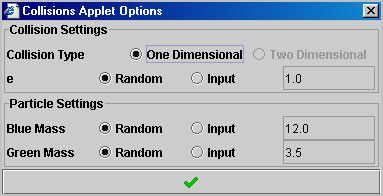
 Pressing the options button (
 ) opens the Collisions Applet Options box. This box allows you to
control the elasticity of the collision (e) as well as the masses of each
object.
) opens the Collisions Applet Options box. This box allows you to
control the elasticity of the collision (e) as well as the masses of each
object.
Preamble
This applet illustrates conservation of momentum and elasticity in one dimensional collisions. As well, it shows how collisions may be viewed from a lab frame and centre of mass frame.
This page is designed to get you started using the applet. The applet should be open. The step-by-step instructions on this page are to be done in the applet. You may need to toggle back and forth between instructions and applet if your screen space is limited.
Pressing the options button (
) opens the Collisions Applet Options box. This box allows you to
control the elasticity of the collision (e) as well as the masses of each
object.
By default, the elasticity and masses are set to random - if you run a new
collision, the applet will randomly generate new values. To enter a
specific value, select input
 ).
). button to close the box. If you have entered specific values, the applet
will keep these values for subsequent collisions.
button to close the box. If you have entered specific values, the applet
will keep these values for subsequent collisions.

Pressing the data button
 )
)
)
The lab frame shows collisions from a laboratory frame of reference. Let's run an example collision and examine this feature of the applet.
Example:
Perfectly Inelastic Collision Analysed in the Lab Frame
A 5.0
kg ball, moving to the right with a speed of 8.0 m/s, runs into another
ball that is at rest and has a mass of 8.0 kg. The collision is head-on
and perfectly inelastic. What is the speed and direction of the masses
after the collision?
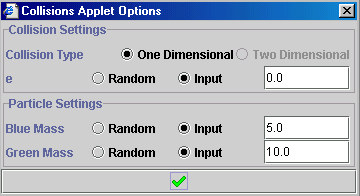
First, let's use the applet to analyse the collision:
)
)

 )
)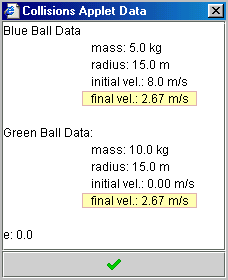
You should see that both balls move to the right with a speed of 2.67 m/s. Now, let's verify the applet and make sure we can calculate the same information:
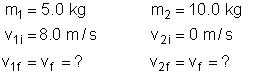
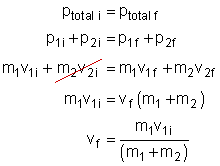

We discover that the green ball moves to the right with a velocity of 2.7 m/s. Our calculations match the applet.
Collisions in the Centre of Mass Frame
The centre of mass frame shows collisions from the centre of mass (CM) frame of reference. In this frame the CM is always held at rest. As an observer, it is though you are standing at the centre of mass. Using the same example as above, let's analyse a collision from the CM frame of reference.
Example:
Perfectly Inelastic Collision Analysed in the Centre of Mass Frame
A 5.0 kg ball, moving to the right with a speed of 8.0 m/s, runs into
another ball that is at rest and has a mass of 8.0 kg. The collision is
head-on and perfectly inelastic. What is the speed and direction of the
masses after the collision?
First, let's use the applet to analyse the collision:
) 
 )
)
|
|
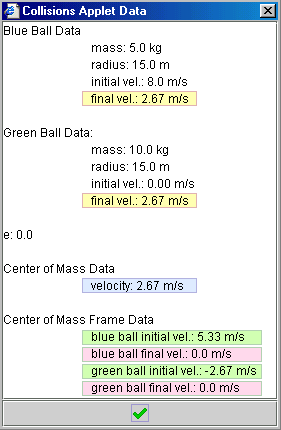
You should see that in the CM frame, the final velocity of both balls is 0, but in the lab frame, the final velocity is 2.67 m/s. Now, let's verify the applet and make sure we can calculate the same information. Note - for significant digits, round off when you write them down, but not when you are doing calculations.


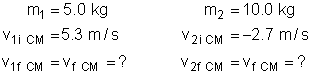
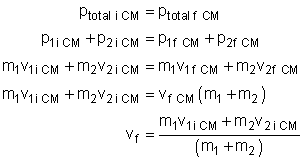


According to our calculations and the applet, in the CM frame, the system comes to rest after the collision - the final velocities are zero. However, in the Lab Frame, the balls move to the right with a velocity of 2.7 m/s, but so does the CM. Make sure you understand the difference between the two frames of reference.